Showing posts with label Modeling. Show all posts

Sunday, January 29, 2023

This model is kaput

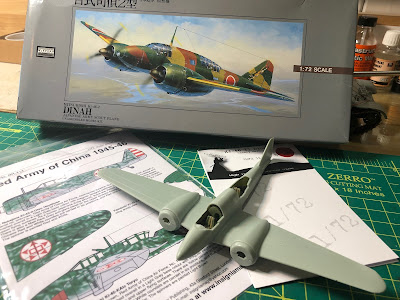
Our hobby should bring us joy, but at the moment this Arii 1/72 Ki-46 Dinah is not.

I wrote about the model a couple of weeks ago, asking myself why I'm building it. I didn't have a compelling reason then, and that feeling of apathy has remained. I haven't looked forward to working on it much less finishing it, and even after getting a coat of paint on the underside (which for me is when the real fun begins), I'm just not feeling it. And so...

I'm done with it.

The canopy has terrible fit, and a seam on the underside of the fuselage has opened up. I could use my basic modeling skills to fix these things, but I don't have it in me to finish it. The time that I spend on this model is time that I could spend on another model, one that truly excites me.


And so, if a model isn't bringing you joy, it's time to move on.

Tuesday, January 3, 2023

Why am I building this model?

Some of you will laugh at me, but I have to fess up.

A few days ago I was filling a nasty seam on this Arii 1/72 Ki-46 Dinah and found myself wondering, why am I building this model?


I've had the model in my stash for over 10 years, and as you can see I've also purchased aftermarket decals and the KV Models Canopy mask.

The thing is, I barely have a passing interest in Japanese aircraft, and I don't have a strong affinity for the Ki-46 in particular. The only reason I can think of for my decision to build the model is that its paint scheme won't be blue or grey. (The last model I built was an F-4S in the Ferris scheme, so to avoid the monotony of painting the same color over and over again, I try to select a different palate for each successive model I build.)

I don't have to tell any of you that when our heart isn't in a build, the process of building the model isn't satisfying. I don't look forward to spending time with the Dinah. Ultimately, I don't really care if the outcome is mediocre.

As I'm building the Dinah, I'm surrounded by a few hundred other models that I find much more compelling. Those are the models that should be on my workbench, not this one nor any other model that doesn't excite me.

I'll share more about the implications of this realization in the coming weeks, but I think it's interesting to consider why we build what we build. Or if we should be building something else.

Wednesday, July 7, 2021

My go-to books

 It’s 10pm. You’re tired. Too tired to work on a model. You’re bored with the internet. But you want to feed your interest in the hobby, so you pull a few books off the shelf and browse them. What books do you typically select?

I had an interesting conversation with friends last week when someone asked what our go-to books are when we want to kill time or find inspiration. Because I often grab a book off the shelf when I want to read in bed, it was pretty easy for me to share my favorites.

Diego Quijano has inspired me for a long time, so his books are always within reach. His encyclopedia series offer a ton of rich content, so every time I browse them I’m reminded to try something new.


I can say the same thing about Adam Wilder’s books on armor. They are perfectly illustrated and offer a wealth of techniques and inspiration.


I’m a sentimental old fool, so Squadron’s line of books have long-offered more than a few ideas and always get my creative juices flowing and eager to start something new.


For armor subjects, Concord’s books are jam packed with excellent photos of armor in action. They are out of print now, but they’re an excellent value when you can find them online or at contests.


There you have it. What books do you find yourself looking at over and over?

Tuesday, November 17, 2020

Getting started with airbrushing

One of the most common subjects of discussion and frustration in Facebook groups — after D-Day stripes — is airbrushing. Newcomers want to know which airbrush to buy, and once they have one in hand, they struggle with its use.

If you struggle, don’t feel bad. Airbrushing is one of the most challenging tasks in our hobby to master, in part because there are so many variables:

  • Your airbrush
  • The cleanliness of your airbrush
  • The paint you use
  • The thinner
  • The paint to thinner ratio
  • The air pressure you spray at
  • Your technique
  • The weather

If you’re new to airbrushing here are a few suggestions based on my experience over the years.


Purchase any double-action airbrush

There are many airbrushes on the market in every price range. And modelers are quick to offer suggestions for all of them. If you’re new, the best advice I can offer is to start with a double-action airbrush in the $30-$50 price range. I want to suggest the Iwata HP-CH that I use, but the $150 price tag is a bit much for a beginner. You can always upgrade as you build experience.

Select just two or three paints

When you’ve purchased an airbrush, your first decision will be which paint to use. It’s easy to be overwhelmed with the choices. You’ll find modelers who are strong advocates for each paint on the market, as well as some who will tell you avoid this paint or that paint at all costs. 

My advice is to but one color from two or three manufacturers so you can use them yourself and choose the brand you like the best. I’d probably recommend:

  • Tamiya
  • MRP
  • Mr Hobby
  • AMMO by Mig

In addition, purchase each manufacturer’s own thinner for now. There are alternatives, but if you’re beginning, best to keep it simple.

Experiment

Before you even think about using your new airbrush on a model you care about, spend a few weeks learning how to spray each of the paints you purchased. Your goal is to simply explore the characteristics of each paint given these two variables -- air pressure and paint-to-thinner ratio.

You’ve probably seen YouTube videos where modelers are pouring paint and thinner directly into the airbrush and mixing by eye. If you’re new, you’re better off building your experience by counting drops of paint and thinner and writing them down for future reference. When you find a combination that works for you, you’ll want to be able to use it over and over. You’re not mixing a lot of paint at this stage, just enough to see how well you can spray the paint. 10-20 drops of paint and thinner will be sufficient for you to apply overall coats of paint and fine lines.

Practice, practice, practice

When you’ve found a paint manufacturer and thinning ratio you like, the next step is to practice on old models. Your goal is to reach a point where you can apply paint to your model with consistent results. When you’re ready to commit paint to a model that’s important to you, the last thing you want is an unpleasant surprise, so taking time to continue to master your airbrush and paint is important.

I hope you find these ideas helpful. Airbrushing is hard, but if you’re diligent and persistent, there’s no reason why you can’t use your airbrush with good results.

P.S. On final thought.... For all that is holy in this world, please, please keep your airbrush clean! A little extra effort after each airbrushing session goes a long way to ensuring your most valuable tool can give you the results you seek.

Sunday, August 30, 2020

7 suggestions for beginners

 I can’t imagine what it must be like coming to the hobby today. Even if your interests are restricted to just aircraft, armor, ships, cars, there are hundreds of kits, aftermarket, and finishing products available that could be overwhelming to the newcomer.

That wasn’t my experience in the 1980s. There were only a handful of kit manufacturers, just two or three aftermarket companies, and no one was producing any weathering products at all.

There's a lot to explore these days, and I see a lot of new modelers asking questions in Facebook groups looking for recommendations on kits, paints, airbrushes, etc. Here are my high-level suggestions if you’re new to scale modeling. Clearly, you’re free to take whatever path you choose, but I think these ideas will put you on a solid path as you learn about scale modeling.

Select good kits

I think it’s important that your first few kits are well-engineered and relatively easy to build. You don’t want to spend time fiddling with assemblies that are over-engineered or trying to fix problems that are the result of poor kit design. Most modelers will recommend Tamiya as the standard of quality no matter your interests — aircraft, armor, ships, automotive — and I agree completely.


Ignore inaccuracies

If you spend more than 10 minutes in any Facebook group or discussion forum you’re sure to see guys pointing out inaccuracies in the kits you have or would like to build. These criticisms are justified, but as you build your first 10 to 20 kits, focus on mastering assembly and painting. You can learn how to fix kit inaccuracies later in your career. You may even learn to love the so-called rivet counters!

Skip the photoetch and resin

There are dozens of manufacturers that offer photoetch and resin to improve your kits, but they often present challenges that will challenge the skills of a beginner. Start introducing aftermarket products as you master the basics.

Buy an airbrush

I hate to recommend that you spend a lot of money from the start, but most modelers will say that an airbrush is a necessity. Yes, you’ll see really good looking models that are brush painted, but those modelers are wizards blessed with skills from the heavens. Most of us rely on airbrushes, even for small subassemblies. With practice you’ll find that an airbrush can produce results beyond a paintbrush. 

Don’t obsess with weathering

Like aftermarket products, there are dozens of weathering products on the market these days. Making sense of them all, much less mastering their use, is challenging. Focus on applying a clean paint job to your model with your airbrush, and then introduce weathering products and techniques later.

Don’t strive for perfection

I really don’t think this is a problem with most beginning modelers, but don't be too disappointed if your first efforts don't look as good as you'd like. Look at each model as a learning experience. Make mental notes (or better yet, written notes) of what didn’t turn out as well as you’d hoped, and look to improve with your next model.

Ask for help

Finally, ask for help. Scale modelers are a friendly bunch, and we’re eager to answer your questions. That can be a double-edged sword at times, as you’re likely to get conflicting advice. Also, don’t be afraid to experiment; each of us has products and techniques that work for us, but you’ll need to find what works for you.

There you go. None of us got where we are overnight, so pace yourself, look at others’ models for inspiration, and enjoy the experience.

Welcome to the hobby!

Sunday, April 26, 2020

Bombs, missiles, and pods oh my!

There’s something about the size of a man’s stash, right? We like to talk about our model collections, whether they’re enormous or modest. I remember a modeler 30 years ago who bought one of every new 1/72 aircraft model as they were released, not unreasonable at the time when there were just six or seven major manufacturers rather than the 25 or more that we have today. If I recall correctly, he had several thousand kits in this stash.

Despite all our talk about kits, what about the other items that take up room in our closets? I’ve seen talk about photoetch and books, but over the last few years I’ve found myself building another stash — resin bombs, missiles, and pods.


There was a time when I didn’t add ordnance to my models. When I got to the final stages of completing a model the thought of spending even a few more hours on the the kit was not appealing; I found the task tedious and time-consuming.

Not anymore! These days I’m intrigued by the wide variety of armament you can hang under an airplane. Ordnance has become compelling. It gives an airplane its character.

The scale modeling aftermarket industry has caught on. Although Hasegawa’s weapons were first released 30 years ago, newcomers have capitalized on the desire of modelers to add weapons to their models. Here are a few manufacturers that are producing some really cool products.

Eduard


Eduard is at the top of the game with their expansive line of Brassin weapons. Like everything that Eduard produces, these bombs and missiles are perfectly manufactured and feature outstanding detail. I think they’ve released pretty much every significant piece of ordnance by now in all three major scales.

Master Model


http://master-model.pl/

Master Model has released a huge variety of gun barrels for all of the most popular aircraft. (And pitot tubes, too.) They’re beautifully turned in brass and are much more realistic than the plastic parts found in model kits.

Advanced Modeling


Russian company Advanced Modeling has given us a huge variety of Russian bombs and pods. And dang, some of these weapons are pretty gruesome looking, like the KAB-1500Kr laser-guided bomb. AM’s quality is excellent, and you should consider them when you’re building Soviet or Russian aircraft.

ResKit


ResKit ordnance is on par with Advanced Modeling. Their line isn’t as extensive, but the quality is excellent. They produce quite a few other resin accessories that you should seek out as well.

Other noteworthy manufacturers are Armory, Air Graphics, Black Dog, L’Arsenal, and RV Aircraft. When you’re browsing the vendors room at contests, look for older manufacturers such as Belcher Bits, Paragon, PP Aeroparts, Dr. Pepper Resin, and Spectre Resins. If I forgot any of your favorites, be sure to add them in the comments below.

A few ideas


Before signing off, I’d like to offer a few suggestions that might help you better manager your stash of ordnance.

Kudos to Eduard for their excellent packaging of their Brassin range of ordnance. The thermoformed package prevents any damage to the delicate resin parts. Unfortunately, they take up a ton of space if you store them as-is. After I buy mine, I remove the resin parts, photoetch, decals, and decals and put them into a small zip bag for storage with other items in a plastic storage container. Yes, you’ll have to be careful when handling the bags, but we modelers know a thing or two about handling delicate items.

Here are photos of the Brassin 1/72 GBU-11 as packaged and after transfer to a plastic bag.


You don’t always have to buy resin ordnance. Many of today’s kits come with ordnance that’s really nice on its own. (Of course some don’t — I’m looking at you, Hasegawa.) Be sure to save these bombs and such for future use, packaging them just as you would any aftermarket alternatives.


Finally, be sure to keep a list of the ordnance you buy. Buying duplicates, because you forgot what you already have, isn't the worse thing with ordnance, but like any stash, knowing what you have is (in my experience) very important to not wasting your money.

And don't forget, it’s ordnance, not ordinance.

Tuesday, January 28, 2020

My 24-hour build experience

The 24-hour group build on Facebook is over, and I’m sorry to report that I didn’t finish my Monogram 1/72 A-1E Skyraider.Time got away from me, despite working on it until 2 am Saturday night. I spent about 14 hours in total, which was almost sufficient to build the model in its entirety. If I had allocated another two hours, I think the model would be complete.


Here’s my after-action report.

What worked in my favor


Despite not finishing the Skyraider, I still think it was a good choice. As I wrote earlier this week, it has very few colors, making painting relatively quick and easy. And luckily I didn’t have to do any touchups.

Pre-planning was very helpful, and I should do this more often. For example, I made sure that when I painted black, I painted the interior, wheels, and prop.

I followed some of my own advice for building models faster, which I’ve written about over the last few years. I painted the interior black, didn’t spend much time on the underside, and didn’t obsess over minor seams.

Finally, I didn’t add much detail. The cockpit is a massive black void of nothingness, but detailing it would’ve sent me down a wormhole of lost time. I thought about replacing the exhaust stubs with brass tubing, but that, too, would’ve cost precious time. I did, however, replace the pitot tube (?) on the vertical stabilizer with telescoping tubing.

What worked against me


The Monogram A-1E features raised panel lines, which I knew I wanted to rescribe. Even though there are minimal panel lines, the task was more time-consuming than I’d expected. And I skipped rescribing the lines on the underside!

Even though there weren’t many colors on the model, I’m fastidious when it comes to cleaning my airbrush. Each airbrushing session is followed by a cleaning, and that was a time suck. I probably spent the equivalent of an hour doing just that.

I underestimated the time required to mask the Skyraider’s canopy. Tedious to be sure! That said, I was very happy with the outcome, a reminder that canopy masking need not be as frightening as always anticipate.

I didn’t  finish the Skyraider, but I’m okay with that. As I told a friend on Saturday, despite the goal of finishing a model in 24 hours, I didn’t want to sacrifice quality. I’d rather stop where I did, take a breather, and wrap up the final tasks over the next week. As I said earlier today, the best part of the experience was simply spending an extended amount of time at the workbench doing what I enjoy most.

The same group of guys has already schedule next year’s 24-hour build, though it appears to be intended only for car modelers. If you’re interested, you can join their Facebook group.

Here are links to my earlier articles about building models more quickly.

5 ways to increase your output
Paint it black and close it up

Friday, January 10, 2020

A 24-hour build

I recently shared a Facebook post from a group of modelers who organize an annual 24-hour model build, this year planned for the weekend of January 25. Their objective is "to get together with friends or by oneself and completely build a model of your choice wholly within a 24 hour period. It is a challenging endeavor but highly satisfying to complete successfully.”

So — Gary, John, Chip, Jeff, Carver, and George — I’m in! I’ve joined the Facebook group to participate.

I’m nervous. I’m a notoriously slow modeler, usually completing only four or five models per year. I’ve often looked to the Christmas and New Years holiday as an opportunity to crank out a single model, but I’ve never been successful. Doing that in 24 hours seems incredibly daunting, but the enthusiasm of this group has inspired me.

Having joined the group, I had to select a model for the build. I really do want to finish the model in the required timeframe, so my choice is crucial to setting myself up for success. After thinking it through, I came up with a few criteria.

  • The model has to be relatively small; the fewer the parts, the better.
  • I like using pin washes, so to avoid having to spend too much time rescribing any raised panel lines, the model would ideally have engraved panel lines.
  • The paint scheme should be relatively simple. Masking, painting, and touching up three or more colors would be very time consuming.
  • The aircraft cannot feature much, if any, ordnance, which would be a big time suck.
  • Most importantly, the model had to excite me. The prospects of spending this time on something less won’t keep me engaged.

I’ve selected the very old Monogram 1/72 A-1E. Yes, it has raised panel lines, but rescribing them shouldn’t be terribly time-consuming, particularly given that the remainder of the kit is very basic. I’ll use Caracal decals for an all-blue AD5, so painting and masking time will be minimized. I built the model back in high school, so there's a strong nostalgia factor for me as well.


I’m excited about this challenge! Anyone care to join the group? Click here to join the Facebook group.

Saturday, March 9, 2019

More base ideas from The Container Store

A few years ago I gave you some creative ideas for bases and mentioned The Container Store as a potential source of items you can re-purpose as bases. I recently visited my local store and noted several items that are currently available. Many of them can be used exactly as purchased, or you can paint them to make them more suitable for your latest model.

Stackable bamboo drawer organizers come in a variety of sizes, and when flipped over and a suitable surface applied (such as sheet plastic or a mirror cut to size), provide a 1-2 inch high base for any model. A bargain at between $3 to $8.


These display cubes come in only two sizes, 6” x 3 1/2” x 6” and 9” x 3 1/2” x 9”, but they’re perfect for armor, vignettes, and small dioramas. They come in brown, white, and black finishes.


These lacquered storage boxes come in four sizes and seven colors, and you can use the box itself for a base (think of the pedestal-like bases popular in European contests) as well as the lid; just flip them over! These cost between $8 and $20.


These accessory trays are similar to the lacquered storage boxes but are more shallow and without lids. Available in three sizes, they’re probably most suitable to small aircraft and armor.


While you’re in the store, keep an eye out for Novus’s polishing products, which you'll need for polishing aircraft canopies. They’re available individually in 8 oz. bottles and as a 2 oz. set.


Remember, the base you use can either complement or detract from a great looking model!

Thursday, November 22, 2018

Time to be thankful again

It’s been three years since I shared the things I’m thankful for, so I thought it time to reflect again on all the good things I enjoy in our hobby.

Scribing tape


I’ve always intended to write about my experience scribing -- because I’ve found it to be quite zen -- but just haven’t gotten around to it. The desire is stronger now after having discovered HIQ Carving Guide Tape via Hobbyworld USA. If you’ve struggled scribing around curved surfaces — trying to apply multiple layers of masking tape to create a scribing guide or cutting long strips of label tape — you’ll find that HIQ’s tape is the bee’s knees.


Modeling reference books


Over the last few years we've seen an explosion of magazines and books describing how master modelers, build, convert, paint, and weather their models. We’ve come a long way from simple 4-5 page articles in magazines. Today you can find a 25-step photo instruction on how to paint and weather a P-51D fuel tank and entire books dedicated to building a single model. With so many books explaining every little technique, there’s seemingly no excuse not to build a decent model.


Video reviews


YouTube has become a prime medium for delivering thorough in-box reviews of new kits. Web sites such as The Modeling News and BritModeller have long offered comprehensive photo coverage of new kits, but a video offers a new dimension to assessing them. Look at the BlitzGreigModelWorks or Genessis Models YouTube channel for good examples.


Facebook groups


I know I’ve been critical of the deluge of groups on Facebook, but the result has been an abundance of information shared from all corners of the globe. I suspect many of the groups we’ve joined have been created by modelers for modelers, but they attract real-world pilots, soldiers, seamen, etc. who are eager to share their photos and experiences. We modelers have everything to gain. I’m still concerned that content is being diluted when there are so many groups intended for the same subject (for example, nearly 15 groups for the F-4 Phantom), but the value of Facebook cannot be denied.

Our hobby


The older I get, the more I realize that most people don’t have a hobby. While those folks are wasting away watching television or doing god-knows-what, scale modelers like us are actively engaged in history, research, and craftsmanship. We’re lucky to have a passion that drives our thoughts and activities on a day to day basis.


Sunday, March 11, 2018

Lessons learned from the Olympics

The Olympics are well behind us now, and after watching a number of the events over those two weeks I’ve been reflecting on what the experience must be like for the athletes who didn't win, or who didn't place as high as expected.


I’ve been an advocate here on Scale Model Soup for entering contests. In light of the Olympic experience, there are a few lessons we scale modelers might consider relative to our participation in contests so that we’re not completely dejected when we don’t win.

Sometimes you have a bad day

American skater Nathan Chen was expected to medal, but numerous stumbles in the short program ultimately put him in 17th place and kept him off the podium.

Lesson: Although the act of building a scale model doesn’t happen within the span of one to three minutes, I think we all know the experience of building a model that doesn’t reflect what we believe to be our true potential. Don’t let one or two shabby models diminish your confidence. Press on and build another model.

Even when you fall short you can still do great things

Speaking of Nathan Chen, even though he didn't medal, he was the first competitor to land five quadruple jumps in one program.

Lesson: Many of you have seen thousands of models over the years, either at contests or online, and a number of them are memorable to you. Did they win first place in their categories? Maybe; maybe not. If your model isn’t perfect — if a significant flaw kept it from winning — remember that it may be memorable to the contest attendees. Build something great and it will be remembered whether you win or not.

You can redeem yourself

Shaun White, who was widely regarded as the snowboarding king, had a disappointing experience at the 2014 Olympics, placing fourth in the halfpipe event. He redeemed himself in PyeongChang by winning gold.

Lesson: So you didn’t win first place in your favorite category? You made mistakes and the judges found them? Pick yourself up, learn how to improve, and try again. The good news is you don't have to wait four years!

The line between first and second place can be razor-thin

In the Alpine Skiing-Women's Super-G, the difference between Ester Ledecka’s gold medal and Anna Veith’s silver was just 1/100 of a second.

Lesson: I’ve judged in enough contests to know first-hand that the line between first place and second place (or second or third, or third and zilch) can come down to the most seemingly inconsequential item. If you fall short of where you hoped to be, remember that what the judges found might have been an incredibly small distinction between you and the guy who won. (Unfortunately in mosts contests you’ll almost never know just how close you came to winning.)

Comparing professional athletes to hobbyists isn’t really fair. Athletes invest much more time and money in their pursuit of gold, but I think we can learn something from the Olympics. If anything we can look to the Olympic Creed, which says in part:

"The most important thing in the Olympic Games is not to win but to take part.”

And so it is with scale model contests as well.

Sunday, October 29, 2017

Multiple builds don’t work for me

I usually have two models on my workbench at any given time, one is in the construction phase and the other is in the painting and weathering phase. This works for me, because I can work on one model while the other one sets up or dries.

Unfortunately, at the moment I have three models on my workbench, each of them in the painting stage, and it’s bumming me out. I’ve been spending a good bit of time at the workbench recently, but progress is slow-going. I'll spend an afternoon on the F-16 and make good progress, but the Harrier and Guardian remain untouched. Or I'll spend two hours masking the Harrier and the F-16 hasn't moved to the next stage.


Completing a model is a satisfying experience, but completion of any one of these models feels like a long way off. I think the only way I can actually complete one of them is to devote my time to just one, then another, and then the third.

In the meantime, no matter how I proceed with finishing them, my interest in other models in my stash is growing. There’s the Academy A-37, for which I pulled a dozen books from the shelf to study loadouts. I’ve been itching to do another multi-engine bomber, so my Minicraft B-24 is calling my name. There have been a lot of conversations over the last few months about Soviet and Russian aircraft, which has been sparking an interest in that genre for me.

When I have multiple models on the workbench, the key — for me — is to stay focused on those projects and not let myself get distracted. I just need to get back down to two models so I can find that focus.

From posts to Facebook groups and discussions I’ve seen online it’s not uncommon for modelers to have literally a dozen or more models in various stages of construction and painting. If you’re one of those modelers, I’m curious to hear how you manage that queue and how it affects your enthusiasm for them.

Friday, October 13, 2017

How to search your favorite web site

There's been some buzz on Hyperscale and ARC recently about the sites' search features. Apparently they're not working as advertised, which I suspect can be attributed to a bug in the software used to host the sites or a bad configuration setting deep in the network somewhere. I’m sure it will be fixed in time, but there’s a very easy and effective way to search your favorite forum or web site that doesn’t force you to rely on a web site’s search algorithm, which can sometimes be hit or miss.

To begin, you need to know the URL of the site you intend to search. It’s that long, sometimes convoluted string of text at the top of your browser window. It looks something like this.


The key component of the URL is what precedes the .com or .net, what’s known as the domain name. In the example above, which shows the News section of Armorama, the domain name is armorama.com. What follows the .com is just the more discrete address to the News section.

If you want to search Armorama, Google is your friend, as they say. That minimalistic search box that you've seen on their home page is all you need. Simply write a search query that's composed of two components.

The first component consists of the key words you want to search. For example, if you’re looking for information about the Takom King Tiger, those three words are probably your best bet. If you are looking for information about King Tigers in general, you’ll probably use just the words King Tiger.

The second component is the domain name of the site you want to search. In our example, that’s armorama.com, but you want to put the word site: in front of it (including the colon), which tells Google, "Hey Google! I want you to look for these word only within this web site. Nowhere else!"

What you wind up with is a search phrase that looks like this.


The search results on submitting the search look like this.


It’s that easy…for the most part.

Here are a few tips from my experience as a software manager in my day job and as a scale modeler who enjoys searching the web.

Google does a good job of displaying what it believes to be the most relevant search results at the top, but if your search returns too many hits, you can narrow the results several ways. Just add more search terms. When I searched for takom king tiger site:armorama.com, you see that I got 504 results. If your interest is specifically in the interior that Takom provides, add the term interior to the search words. That reduced my search results down to 222 pages.

Use quotation marks. When you put a search phrase in quotation marks, Google will look for that precise string of words. For example, if I search “takom king tiger” site:armorama.com Google will give me only pages with that specific phrase. It won’t return articles about the Dragon King Tiger, unless that model happens to be mentioned on a page where the phase Takom King Tiger is found.

Google lets you refine a search by date, displaying only those web pages that were created or updated within a specified period of time. From the search results, click the Tools item and then select the date range you want to use, or enter your own using the Custom Range option.


Maybe you’re searching for information about the King Tiger and seeing too many articles about the Takom kit. You can exclude pages from your search results that contain the word Takom by putting a hyphen (the minus sign) in front of the word you want to exclude.


There are additional ways to restrict your search. You can learn about them on Google's support site, or you can use Google’s own Advanced Search page if you don't want to commit these specialized strategies to memory.

A brief note about searching scale modeling web sites, and particularly discussion forums.

Your search results are relevant based not only on the search terms you choose but also on the words that web site authors and forum participants use. For example, if you’re looking for information about the F-105’s use in Vietnam and using the search terms thunderchief vietnam, you’re likely to miss pages and discussions where all references to the aircraft are as the Thud. Or maybe you’re looking to see if the AIM-9M was used in the Gulf War but everyone referred to it as the Nine-Mike ‘Winder. As you compose your search, think about other ways that modelers might have talked about the subject. (And if you contribute to online conversions, try to use widely accepted words and terms so that your wisdom can be found in the future.)

Like scale modeling itself, searching is a skill that takes trial and error to give you the confidence that you’re getting the information you seek. There’s an incredible amount of information out there that’s literally at your fingertips. Go get it!

Friday, September 29, 2017

Reconsidering cheating

My recent article about the use of aftermarket really struck a nerve among a large number of you. Based on the comments I received here on the blog, on my Facebook page, and in a closed Facebook group you vehemently disagreed, and you didn’t mince words in letting me know. It's even resulted in a new hashtag, #cheating. To you I say…message heard loud and clear!

Demonstrations outside the Scale Model Soup editorial offices last week.

I love the passion you have for our hobby, and I appreciate your feedback, no matter how you expressed it. I always listen to criticism with an open mind and re-evaluate my opinions when presented with new information and viewpoints, and I see now that I fell short when it came to my views on "cheating."

Where was I off base? Two things come to mind.

In hindsight I think the word "cheating" was unnecessarily pejorative and accusatory. Cheating implies you’re doing something wrong. As many of you pointed out, this is a hobby where each of us is building models for ourselves, so how can you "cheat?" A better term would've been "taking shortcuts." For example, if I drive from Atlanta to Dallas and take a shortcut to save an hour off the drive, no one will accuse me of cheating, right? Let’s go with "shortcut" going forward.

My second gaffe was my overestimating the importance of craftsmanship in the hobby — that is, the process of building a model. Many of you commented that the ends (the model in your display case) is more important than the means (the products you use to create it). You’re willing to take shortcuts to create a satisfying representation of a favorite aircraft, tank, ship, or vehicle; you have no interest in detailing cockpits, reshaping inaccurate noses, or adding plumbing to landing gear bays. I get that now.

So here I am a week later with a better understanding of how others enjoy the hobby. I knew that writing a blog would be a learning process and might be difficult at times. Here’s a sample of some of the feedback I received.

"Scale modeling is a fantastic example of one arena wherein you're forced to become proficient in a series of skills in order to produce something truly beautiful."

And…

"There is some skill and craftsmanship needed with some of the aftermarket stuff. I'd like to know how bending and or rolling photoetch does not require skill."

And…

"I absolutely agree. I mean, craftsmanship is what we do, right?" But, he continues, "Does the proliferation of aftermarket really diminish the skill sets of craftsmen, or does it inspire and draw in modelers, encouraging them to try things they might have feared to try?"

These are good points that I hadn’t considered deeply enough. Ironically, as I wrote that original article I was selling a particularly complex photoetch set because I don’t have the skill required to assemble it. My hat’s off to those of you who can work magic with photoetch or are willing to take the time to grind and sand a resin cockpit or engine to fit it into a model. That’s craftsmanship. Frankly, anything that motivates you to build model after model is good for the hobby.

"The older we get...I'm 56, the less and less time I will be able to build what I have. So I buy the stuff that corrects what I would have to do but now don’t."

I can relate. I’m fast approaching 50 myself with more models in the stash than I have time to build. I've written about how to speed up your builds and increase your output. If aftermarket lets you do that, that’s a good thing.

"Results are what count, not the process." 

And…

"Are you trying to show off your personal skills, or are you trying to build the best possible scale representation of the prototype? Personally, all I care about is the finished model."

Several of you told me that the end model is the important part of the hobby to you. That’s as valid an approach to the hobby as any other. One person implied that he’d like to scratchbuild but knows he doesn’t have the requisite skills. He said, "So what happens when you scratchbuild your own parts and they suck?" In response I’d say that you learn from the experience and try again...if you want to. My own use of pigments ended horribly, as did my first attempt at rigging a 1/72 biplane, but I press on with the hope that every model I build gets a little bit better.

"The arrogance of everyone has to enjoy the hobby in only the way I see fit."

And…

"Everyone needs someone else to look down on I guess."

And...

"I just checked my workshop rule book and it reads this guy's an ass."

I’m sorry you interpreted the article that way. Some of my statements were a bit harsh, even though I admitted that I cheat, too. No one has the right to tell us how to build our models, but everyone has the right to talk about the choices we make.

And since I opened the article with an analogy to cooking, one reader took me to task in the kitchen.

"Chances this guy has ever made his own gravy? I'm guessing about 10% so he cheats at breakfast."

Actually, I do make my own sausage gravy. And my own BBQ sauce, my own tomato sauce, my own coleslaw, and my own ice cream. Cooking is my other passion, and I most enjoy preparing meals when I can do so from scratch. I do admit that I keep a jar of Progresso tomato sauce in the cupboard for weeknight meals. A shortcut? Yes.

"Make sure to ask him if it's cheating if he doesn't approve comments that disagree with him."

No cheating here. I don’t delete comments, not from my blog nor from my Facebook page. In fact, the harshest comments I received were in a Facebook group where I have no ability to edit them, and I’m sharing a few here.

"Make sure you have an adblocker of some sort enabled so he doesn't get any revenue from the traffic generated."

And...

"Its all clickbait. Some of the modellers that have pages/websites/youtube channels have started to follow the mainstream media style of posting inflammatory articles, causing a plethora of emotion and plenty of web clicks/page hits. They then go to manufacturers saying 'I have xx amount of hits today, give me free stuff, and you'll get xx amount of people seeing your product…'"

Fake news. Clearly, this person has never visited Scale Model Soup otherwise he’d know there are absolutely no ads on the blog. I average only 75 page views per day, which might generate two or three dollars a month at best, and certainly not enough to entice anyone to give me free products. I have just over 1,000 Likes on Facebook, which pales in comparison to other bloggers who have 10-20 times more. No one is thinking about me when they want to promote a product.

Finally, I’ll leave you with this exchange, where M. asked, "Who gives a shit what he says? Its his opinion...doesn't affect or change anything,” to which B. responded, "I need something to get mad about or my time is being wasted on the web.” I think that pretty much explains this whole kerfuffle.

Back to the workbench, with or without aftermarket.

Sunday, September 17, 2017

Sausage gravy and the slow demise of craftsmanship

Editor's Note: After you read this article, be sure to read my follow-up, Reconsidering cheating.

Having grown up in the South one of my favorite breakfasts is sausage gravy over biscuits. After I graduated and left home I enjoyed frequenting a little mom & pop restaurant when I was home on vacation, always ordering the gravy and biscuits. It wasn’t the best I’d ever had, but I liked the idea of getting home cooked food over the mass produced stuff served in chain restaurants. You can imagine my dismay when I peeked into the kitchen during one visit and saw the crew opening a can of pre-made sausage gravy. I never went back to the restaurant again. They were cheating, taking short cuts to satisfy their customers. (On hindsight that probably explains why I could eat breakfast there for around five dollars.)

Two weeks ago there was a brief but lively debate on the WingNut Wings Fans Facebook group when one of its members posted a link to LF Models’ new prefabricated wooden propellers. Several of us expressed our view that using these prop constituted something akin to cheating. One member said, "This is modeling equivalent of turning in homework that you didn't do yourself." He's right.

LF Model's propeller for the Albatros D.I-V, Fokker Dr.I and D.VII, Pfalz D.III, and Roland D.V and C.II.
To be sure, the propellers looks amazing, and why shouldn’t they? They appear to have been manufactured exactly like the real thing, with laminated layers of multi-color woods, shaped, and polished, complete with an aluminum hub. The “modeler” will spend more time removing the prop from the packaging than he will attaching it to the model.

As you might imagine more than a few modelers in the Facebook group will buy LF’s props, and predictably they defended their right to do so. I don’t begrudge them the desire to create a better representation of an Albatros D.III or Fokker D.VII, but I do believe that using these props removes a good bit of craftsmanship that forms the basis of scale modeling. Using these props is cheating. Period.

“Cheating?” said another member. "If this is cheating then so is using Eduard photoetch, Yahu instrument panels, and resin replacement parts.” And he’s absolutely right. When you use those products, you introduce elements into the model that aren’t the product of your mind and hands, and the your model then only partially reflects your skill as a modeler. You’re another one, two, three steps further removed from being an "artist" (not that modeling is art). Yes, there is a degree of skill required to properly clean up, assemble, attach, and paint photoetch or resin, but not nearly as much as creating those components yourself using plastic, metal, and other media. One of the modelers that inspired me early on, Bob Steinbrunn, used very little, if any, aftermarket and produced amazing representations of aircraft in scale. He, my friends, is a true craftsman.

Some of you reading this will take my argument to an extreme, setting up a straw man by suggesting that modelers should create their own paint and glue. Or scratchbuilding models completely, eschewing kits entirely. That might be true, but I’d make a distinction between products used to construct and paint a model and products used to replace or add components of a model.

Here’s the deal. If you use wooden props, photoetch, resin cockpits, and so on, it's okay. There are valid reasons for doing so, but admit that you’re cheating. It’s okay to take shortcuts to create the models that you want to display in your display case, but realize that a bit of your craftsmanship is lost in the process.

I’m a cheater myself. Look at the photo below, which shows a small selection of the canopy masks, resin, and gun barrels in my stash. I could mask canopies on my own (as I am for an ESCI 1/72 AV-8A Harrier), but Eduard’s and Peewit’s products make the painting process faster and the results more predictable, and that is important to me. And maybe those wooden props are important to you.


We're cheaters.

You can learn more about the LF Models wooden propellers here.

Thursday, May 18, 2017

The joys of old decals

There’s no shortage of aftermarket decals these days with dozens of companies producing decals in every scale and for nearly every subject. Sadly, some of these decals don’t perform very well. No names, but there are plenty of conversations on the forums and Facebook with modelers expressing their frustration over decals that are too thin, fold over onto themselves, break up, or are simply inaccurate.

Amid all these choices it’s easy to forget the forerunner of the aftermarket decal business, Microscale. I’ve collected a ton of their decals over my years in the hobby. None of today’s manufacturers has come close (yet) to producing as many choices as Microscale (and later Super Scale). Unfortunately, I’ve learned the hard way that their older decals can be fragile. Quite often they'll shatter into a million pieces as they come off the backing paper.

That’s why it’s always a treat to use a really old set of decals and not experience any issues. That was my experience as I finished my Hasegawa 1/72 Ki-51 Sonia a few weeks ago. The kit decals were terribly dry and yellowed, so I dug into my (decal) stash and found sheet 72-5, which might be older than me. (Does anyone know when Microscale started producing decals?)


A day or two after the usual application of Future floor wax on the model and using Microscale’s Sol and Set products, I was pleasantly surprised to find that the decals did not shatter and laid down onto the model quite nicely. They’re not as thin as Microscale’s later releases, but all things considered, they look decent. A bit of Solvaset didn't hurt.

The lesson is, don’t dismiss older decals. They might just work out.

Wednesday, March 22, 2017

Fencecheck is no more

One of my favorite web sites for modern military aviation has long been Fencecheck. It was a hangout for aviation photographers — amateur and professional alike — and was a valuable repository for us modelers. Unfortunately, I learned over the weekend that the owner of the site has shut it down.

The good news is that many Fencecheck participants are now collaborating and sharing photos in a new group on Flickr, aptly named Re-Check, which is fine for new photos going forward, but what about all the photos that had been posted on Fencecheck?

All is not completely lost. Although there’s no way to view the old discussion threads (they’re not accessible via the Wayback Machine), you can find many of the photos using Google. Here’s how.

Let’s say you’re looking for photos of T-38Cs for your upcoming build of the Trumpeter kit. Go to Google Images and enter this search query:

“T 38C" site:fencecheck.com/forums/


Most — but not all — of the resulting photos should be accessible. Simply click on an image, click the View Image button, and enjoy the photograph.

You can search for photos of any other aircraft, base, exercise, or unit by replacing T-38C as appropriate, for example Red Flag. And if it’s not obvious, you can use the same search strategy to find photos from other web sites; simply replace fence check.com/forums/ with the URL of the web site of interest.

Happy searching!

Sunday, March 5, 2017

Don't fix your mistakes

My decals silvered. What do I do?
How do I repair a cracked canopy?
The wings on my aircraft are misaligned. How do I fix them?

I often see questions like these on the forums and my gut reaction is usually to say, “Don’t fix it.”

We modelers can be perfectionists. Even though most of us aren’t driven by competition (it's true), we want our models to look good, and we’re usually willing to work and re-work a scratchbuilt detail, a troublesome seam, or a challenging paint scheme for hours on end. But at the end of the day, what’s so terrible about having an imperfect model in your display case, particularly if you intend to improve with every new model, year after year?

I found myself in this situation on my build of Trumpeter's 1/35 Pz.Kpfw 38(t). I attempted to use pigments on the model and the results were, well, pretty shitty. (Kudos to those of you who’ve mastered the black art of pigments.) I could repaint the model and start over, but that’s time that will be better spent on a new project where my enthusiasm is higher.


In our quest for perfection we forget that this hobby is a journey. Every model is not going to be perfect nor will every model meet your expectations. You’re going to make mistakes and bad choices along the way, and models will leave your workbench that are disappointing. That’s okay. There’s always another model in the stash whose prospects are higher than the last one, and that’s where you’ll apply what you’ve learned.

My advice is this. Allow yourself to make mistakes, and don’t fix them. Let them remain visible as reminders to not to that again.

Don't believe me? Here's a real artist's take on the subject.


Thursday, February 2, 2017

Other voices: The Kitty Hawk 1/48 Su-17 and criticism of new kits

Paul Cotcher of Red Star Scale Models is back for another contribution to our Other Voices series. Paul has long had a strong interest in Soviet and Russian subjects, so it's only appropriate that you hear his comments on the new Kitty Hawk Su-17 and the response from rivet counters upon seeing it.

- - - - -

Fair warning, this article is the modeling equivalent of our parents describing walking to school in the snow, uphill – both ways. Time to practice a little modeling relativism, so if that might push your buttons, you may want to stop reading now. Otherwise, let’s take a trip down memory lane.

In the days before the internet, every trip to the hobby shop could bring a surprise, there were no CAD renderings posted ahead of time, no product listings, no Facebook (or Hyperscale, ARC, or even rec.models.scale). And if the local hobby shop wasn’t good enough, a trip to an out of town hobby shop could bring even more modeling goodness. In the early 90s I frequently travelled to Miami on business, and used those trips to frequent Orange Blossom Hobbies. Not only did I get to meet a bunch of people that I still consider good friends, every trip revealed something new that I had never heard about before. Those of us that have been around the hobby for a while can certainly remember these discoveries.

This specific story, however, relates to a different out of town shop. Traveling to New York City, one would have thought that there would have been a grand and glorious hobby shop somewhere in that metropolis. Ace Hobbies, formerly of mid-town Manhattan provided plenty of exotic products that you wouldn't find elsewhere. Their product listings in the old Military Model Preview magazine would have led one to believe they were much larger. Frequently getting kits, magazines, and supplies from Eastern Europe (apparently from pilots flying in and out of JFK). That was more than enough to get me to visit. Having always been a big fan of modeling Soviet and Russian subjects, anything that was then coming out of newly opened eastern Europe was modeling gold! Alas, Ace Hobbies was far from grand and glorious, it was a dark little place in the shadow of the Empire State Building. Located on the third floor up an elevator that likely later posed as the elevator in the Big Bang Theory, you’d enter the small space to find a pile of kits strewn about in no particular order, save for the few kits on a somewhat center table that were the “new items.”

On a visit one summer day, I recall walking in (after the ride up from Bucks County, PA where I was staying) ready to shuffle through the dusty piles, after all, that’s what was required to really find what was in stock at this (and so many other) shop. What to my amazement should appear but a brand new 1/48 Su-17 from KP. Talk about modeling gold! A 1/48 swing wing Fitter! I was in modeling heaven. Not thinking for a minute, it was going home with me. Of course, they didn’t take credit cards, so I had to ask that they hold it while I went to find an ATM. Long story short (no, Steven Zaloga, you can’t have it), it was on its way home with me.


First inspection showed that it looked a lot like an OEZ kit. Which later was confirmed. OEZ had sold their efforts to KP (Kopro) resulting in their last tooling showing up under a different brand (I guess at one time they had a MiG-23BN planned, too). It was certainly more refined than the Su-7 that I had previously built. Still crude (mid-90s crude) in some areas, but again, better than the other OEZ kits I had in the stash (keep in mind there was no Academy MiG-21 yet, so that included the OEZ MiG-21 kit).

Fast forward a few months, maybe even a year or so, and it was time to build the beast. Likely the release of the Cutting Edge cockpit for the kit was what pushed the project over the Go line. Like most projects it was simple to get the cockpit together, but the small amount of work in to get the resin fit to the kit, and then the fuselage together. After all it was just two fuselage halves, putting those together can’t be hard. But (and here’s the but), from that point in the project fought me every step of the way. Things I remember being difficult include the main wheel well where half the well wall was molded with the upper half of the wing and the other half was molded with the bottom half. Well that will leave a heck of a seam...if the two wheel well halves even matched up. They were so offset that a totally new set of walls had to be fabricated to get one smooth wall all the way around. Seemingly everything had to be trimmed, shimmed, blended, or otherwise spackled in place. Pylons were not molded to one side of the wing or the other, and had to be filled and carefully blended. The large wing fences were split requiring careful filling and sanding. The landing gear was an atrocious approximation of the complex gear on the real aircraft (heck we had new books coming out to show us what these things really looked like). One problem after another. And let me be perfectly clear here, I am only glossing over the bigger issues.

Suffice to say, I fought it all the way to the finish line, and LOVED every minute of it. It was a 1/48 Su-17, and I was darned glad to have one to build. Despite this, I had others in my collection over the years, and even built up a host of additional details to do a “really nice” build. Cutting Edge cockpit, exhaust and outer wings, resin wheels from TallyHo!, a host of etching from Eduard and Part, weapons and pylons from Art Model, and then at the very end came Ciro and their glorious wheel wells (that fixed the out-of-register main wheel well halves). All of this would have made for some spectacular detailing on a kit that was still a bear to build. Project cost was probably in excess of $250 by the time you secured all the add-ons – not to mention some aftermarket decals. Despite many false starts I could never get myself to really engage on the project again. Would get the kit out, tinker a bit and then turn my attention to something newer.

In the two decades, give or take, since I built the first one, I never built a second. I am a far better modeler now then I was then. Better not only in terms of skills, but also better in terms of tools, materials and techniques that have come to light since that time (I mean, Squadron Green putty, am I right?). As we moved into the last four or five years with the onslaught of new 1/48 jet kits, it then became a matter of time before a new Su-17 would present itself and I would be able to build a new and improved Fitter (and the good Lord willing, all the earlier versions too).

So where is this whole thing going Paul, that’s a great story, but what’s your point here?

Thanks for asking! There is most definitely a point. Today, on my front porch, I found laying a brown corrugated box in the characteristic model kit dimensions. In that box, was a brand new 1/48 Kitty Hawk Su-17M3/M4. The kit is GLORIOUS. I’ll have details on my website and Facebook page (probably by the time you read this), but in the interim, let’s talk about why it’s a great kit, and why you almost certainly will have heard otherwise.


From the moment this kit was announced, it was already decried as a piece of garbage. Because of brand alone, it was already doomed in the eyes of many. Doomed not only to those that like to use such statements as “debacle” or “dumpster fire” or even “horribly misshapen monstrosity” to describe flaws in kit designs, but doomed to the people that just read those statements in passing and assume them to be gospel. After all everything you read on the internet is true, right?

Unlike the good old days, we get to carefully monitor each dumpster fire in progress, much like the 24 hour news cycle. Each step of a release is carefully charted on modeling forums everywhere. Announcements are made, CAD renderings are displayed, test shots come out of the mold machines, first kits are assembled, early releases reviewed, and only then does a release get to mass market. By that time the Photoshop and red pen brigade have sliced and diced every nuance of every photo.

So as we proceeded through the release process on the Kitty Hawk Su-17, we see the CAD, and it looks pretty good. We see updated CAD, still pretty darned nice. We see the first test shot build – wow that looks great! We finally see parts on the trees, those looks great, too. Wow, it’s a legit 1/48 Fitter! Yet even with all of this, the haters are still there, and more importantly those that read the hate go into the release expecting it to be wrong and not worth their while.

Here is why the negative point of view, relatively speaking, is incorrect. Let me make this VERY simple:

You ready?

Gonna be hard for some of you to comprehend, but...

IT’S NOT THE OEZ/KP/KOPRO/KARAYA/EDUARD KIT.

End of discussion. Somehow we’ve gotten ourselves into the practice of comparing every kit to some idealized non-existent kit that can never be achieved. Yeah, there’s Tamiya, they seem to be the best blend of engineering and fidelity, but they come at a price, and come out with maybe one subject a year. We need to stop comparing against unrealistic ideals and maybe look at some more realistic comparisons – like what else is out there in the 1/48 Su-17 space? Here’s a clue: It’s that project I so lovingly described above. It was a beast to build, it was full of accuracy issues, and to get it to a similar standard, would cost three to four times as much as this new kit will cost. Fair and full disclosure – there is a Hobby Boss kit coming of the same subject – not sure when, but it’s in their catalog. Maybe that will fix the canopy issue, but from what we’ve seen of early test displays, it’s not as accurate as the Kitty Hawk kit. Beyond that, you’re hoping that somebody else does a better job, but at this point you’re hoping for something that’s FAR down the road, and nothing more than a wish at this point. Kitty Hawk, Hobby Boss, Ideal Future Kit or KP – that’s your choice. Nope, sorry, I forgot one, there's the Evergreen kit too. There's always the Evergreen kit.

So back to that whole modeling relativism thing. We need to stop comparing to the imaginary and start looking at what’s in front of us. Ninety-five percent of kits are really good releases and so far and away better than what has come before. We’ve lost track of that. Every once in a while something really superb comes along, but even then, there’s a flaw somewhere, or the panel lines are too heavy (even if everything else is near perfect), but those releases are the exception and not the rule. Secondly, if you’re really into a given subject, you’re going to be willing to put more effort into the build then somebody only casually interested in the subject. That said with the huge variety of new kits coming, there has to be just about something for everyone at this point.

And yes, I get it, we want to hold the manufacturers to a higher standard. The reason why the kits are so good today is because of the input that has been received by customers over the internet years of modeling.  But while the standard has gotten better and better, the complaining about accuracy issues has not. Endlessly chasing down accuracy issues comes at a price, and in most cases, manufacturers will cut a corner here and there to keep the price of a given release in the reasonable range.

So the next time you want to build a given kit, here are a few pieces of advice:

  • Look up hyperbole (see also click bait) in the dictionary, then look at many other pieces of new, postings or similar pieces of content (whether modeling related or not). It will put things in perspective.
  • Stop worrying about what’s being said online about a kit or manufacturer. Chances are it’s something you’d never see if a subject matter expert hadn’t pointed it out in the first place.
  • If you’ve built a few models, chances are you’ll be able to overcome any fit issue that you come across. Remember these are model kits and not Lego sets. Maybe the whole “kit doesn’t fit” issue is something that I need to address in a separate article (this one is long enough).
  • Don’t apologize for what you’re building because somebody said something bad about the manufacturer or the kit. If you like it and had fun with it, a lot more people want to hear about your experience with the kit than with further comparisons to the imaginary ideal. Guaranteed that 90 percent of the folks who view your model, whether online or in person, will be blown away by the effort.
  • If you’re into a given subject, build the kit, because chances are a better kit is a lot further out than not. Unless it’s a P-51 or a Tiger tank, there will be another release of one of those in five, four, or three years.

Finally, it’s a hobby, it’s supposed to be fun, build the darned thing and stop worrying about what some expert said.

If I can build and enjoy the KP 1/48 Su-17, then it’s a virtual certainty that you’ll be able to enjoy the Kitty Hawk release. All a matter of perspective.


The opinions expressed above are those of the contributor and not necessarily of Scale Model Soup.